
Battery Desulfator, Automatic Pulse Lead-Acid Battery Reconditioner for Life Extension and Repair (PL04C-400AH Blue)
3.9Editor score
Automatic pulse technology
Simple installation process
Maintains battery health
This guide compares ten top battery desulfator solutions to help you restore lead acid batteries and extend their lifespan effectively.
Battery desulfator solutions offer a practical way to revive aging lead acid batteries by removing harmful sulfate buildup. These additives and electronic devices aim to restore charge capacity and extend useful life across various applications.
We evaluated ten leading products based on user feedback, technical specifications, and reported effectiveness. Our analysis covers both liquid additives and pulse-based electronic desulfators designed for different battery types and sizes.
Each selection highlights key features, compatibility, and typical use cases to help you make an informed decision. Please note that availability and pricing can change frequently, so verify details before purchasing.
3.9Editor score

4.1Editor score

3.8Editor score
The following table provides a side-by-side overview of each product's core specifications and intended use cases to help you narrow down your choices quickly.




This 64oz liquid additive targets lead acid batteries by aiming to restore performance and extend useful life. It holds a moderate rating but appeals to users seeking a chemical approach to sulfate removal.
We may earn a commission when you buy through this link, at no additional cost to you.
The product claims to improve chemical balance within the battery to boost charge capacity. It is designed for broad use across cars, golf carts, and other machinery running on lead acid power.
While effective for many, results can vary depending on battery age and condition. It does not work on all battery types and requires consistent charging cycles after application.
Consider this if you have aging flooded lead acid batteries that still accept a charge. It offers a cost-effective alternative to immediate replacement for those willing to invest time.
The formula aims to remove harmful sulfation buildup to increase charge capacity and significantly extend overall battery life.
Carefully formulated to ensure a safe restoration process that protects internal components from damage.
We may earn a commission when you buy through this link, at no additional cost to you.
This one-gallon refill option is ideal for managing multiple batteries in fleet or professional settings. It uses a non-toxic formula to chemically dissolve sulfate crystals blocking electrical flow.
We may earn a commission when you buy through this link, at no additional cost to you.
Customers often report measurable improvement after regular charging cycles. The large volume makes it economical for golf courses, marinas, or anyone maintaining several units at once.
It is not suitable for completely dry, frozen, or sealed battery types like AGM and gel. Success depends on the battery still accepting a charge before treatment begins.
Choose this if you need a bulk solution for flooded lead acid batteries in vehicles or equipment. It balances ease of use with a commitment to safety and domestic production.
One gallon treats 3 to 6 batteries and is ideal for golf courses and marina operators.
Produced and bottled in the USA ensuring quality standards and safe handling.
We may earn a commission when you buy through this link, at no additional cost to you.
SPARK offers a focused solution for golf carts and similar applications using flooded lead acid batteries. The 64 oz bottle is designed to treat an entire battery pack with leftover solution.
We may earn a commission when you buy through this link, at no additional cost to you.
Its formula penetrates cells to dissolve sulfate deposits limiting charging efficiency. It works best on batteries that still accept a charge but have reduced runtime.
While the rating is decent, it is not compatible with AGM, gel, or frozen batteries. Best results are typically seen on units between one and five years old.
This is a solid choice for budget-conscious users with standard lead acid packs. It provides a straightforward way to extend life without expensive replacements.
More than enough product to condition all batteries in your golf cart.
Proudly produced and bottled using quality-controlled manufacturing standards.
We may earn a commission when you buy through this link, at no additional cost to you.
This electronic device uses high-frequency pulses to rejuvenate lead-acid batteries without draining them. It stands out for supporting a wide voltage range from 12V to 72V and multiple battery chemistries.
We may earn a commission when you buy through this link, at no additional cost to you.
Users note it takes two to four weeks to see improvements due to the gradual desulfation process. It includes safety features like reverse polarity protection for reliable long-term operation.
It is not a charger but works best when paired with one during cycles. It is ideal for those with varied systems including solar storage and marine units.
Select this if you need a versatile hardware solution that avoids chemical additives. It offers a non-invasive way to maintain battery health across different setups.
Ideal for cars, RVs, solar systems, and marine applications with 12V to 72V batteries.
Includes smart low-voltage cutoffs and reverse polarity protection for safe operation.
We may earn a commission when you buy through this link, at no additional cost to you.
Battery Renew targets serviceable lead-acid batteries still accepting a charge but holding less power. The one-gallon size makes it practical for operators managing multiple vehicles or carts.
We may earn a commission when you buy through this link, at no additional cost to you.
It is formulated to break down sulfate buildup on plates and restore charging capacity. Users often find it most effective on batteries between one and five years old.
It does not work on AGM, gel, or completely dry cells. Results depend on allowing regular charging cycles for up to ten days after application.
This option suits fleets or households with several lead acid batteries needing routine maintenance. It offers a domestic alternative to buying new units regularly.
One gallon treats 3 to 6 batteries depending on voltage and cell count.
Produced and bottled in the USA ensuring it meets highest quality standards.
We may earn a commission when you buy through this link, at no additional cost to you.
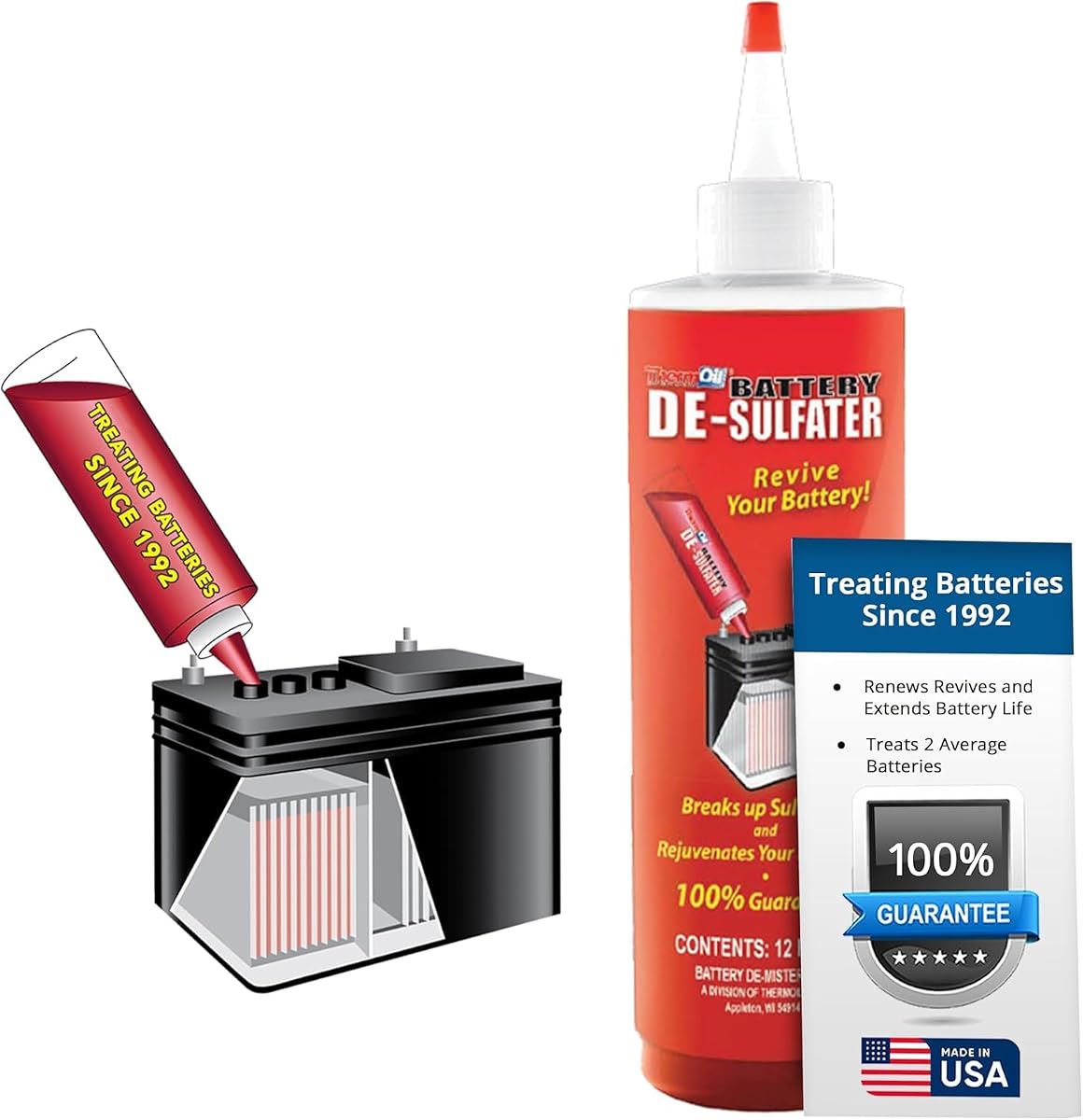
This 12oz additive emphasizes safety by excluding Epsom salts often found in cheaper alternatives. It aims to break down sulfation corrosion while preserving battery integrity over time.
We may earn a commission when you buy through this link, at no additional cost to you.
Users report reduced internal heating and increased power efficiency after use. The formula is non-hazardous and designed for ease of use as an electrolyte additive.
The small size may require multiple bottles for larger batteries or fleets. It offers a guarantee to reassure buyers of its reliability and performance claims.
Consider this if you prefer a compact, safe solution for occasional maintenance. It is suitable for smaller systems needing targeted chemical treatment.
Thermoil De-Sulfater contains zero Epsom salts unlike some other cheap liquid desulfators.
Non-hazardous formula is safe for all lead-acid batteries.
We may earn a commission when you buy through this link, at no additional cost to you.
This larger 64oz version provides more solution for multiple cells or batteries in a single purchase. It shares the same formula as the smaller size excluding Epsom salts entirely.
We may earn a commission when you buy through this link, at no additional cost to you.
The product aims to eliminate resistance by up to 50 percent while preserving battery health. It is designed for ease of use as a simple electrolyte additive.
While the rating remains modest, the volume offers better value for users with several batteries. The guarantee supports confidence in its safety and reliability claims.
Choose this if you need a safer chemical option for home or light commercial use. It balances capacity with a focus on non-hazardous ingredients.
Preserve the integrity of both new and used lead-acid batteries with this protector.
Non-hazardous formula is safe for all lead-acid batteries.
We may earn a commission when you buy through this link, at no additional cost to you.
This auto-setting device detects battery voltage and applies high-frequency pulses to prevent lead sulfate crystal accumulation. It works on batteries up to 400 AH within a 12V to 48V range.
We may earn a commission when you buy through this link, at no additional cost to you.
Users feel performance improvement after two to three weeks of continuous use. It is simple to connect and can run alongside a standard charger for better results.
Battery voltage must be above 11.5V for the device to function properly. It offers an automated hardware approach to maintaining battery condition without manual adjustments.
Select this if you want a hands-off tool for keeping batteries in shape. It suits larger batteries needing steady, pulse-based maintenance over time.
Sulfuric acid and lead react to turn into lead sulfate crystals which is the main reason.
Adopts high-frequency peak pulse to prevent lead sulfate crystals from sticking.
We may earn a commission when you buy through this link, at no additional cost to you.
This solution focuses on restoring charge capacity in flooded lead-acid batteries for golf carts and similar uses. It offers a 64 oz bottle suitable for treatment and preventative care.
We may earn a commission when you buy through this link, at no additional cost to you.
The formula works to break down sulfate buildup allowing batteries to accept a stronger charge. It is most effective on units between one and five years old.
Results may vary and it does not work with AGM, gel, or frozen batteries. The lower rating suggests mixed experiences compared to other products in this guide.
Consider this if you have flooded batteries needing chemical maintenance and want USA-made goods. It remains an option but verify suitability before purchase.
Save money by improving battery performance before investing in costly replacements.
Proudly produced and bottled in the USA using quality-controlled manufacturing standards.
We may earn a commission when you buy through this link, at no additional cost to you.
This device uses pulse technology to recondition lead-acid batteries automatically through controlled cycles. It supports various types including marine, RV, and deep cycle units.
We may earn a commission when you buy through this link, at no additional cost to you.
Installation is simple with direct connection to battery terminals. It helps dissolve crystal buildup to restore capacity and extend useful life without chemical additives.
It offers a hardware solution for users preferring maintenance over pouring liquids. Results depend on consistent connection and the battery's current health.
Choose this if you want a reliable automatic tool for ongoing battery care. It provides a hands-off approach to maintaining charge capacity over time.
Features pulse technology that automatically reconditions lead-acid batteries through controlled charging cycles.
Utilizes specialized electronic pulses to help revive and maintain battery performance.
We may earn a commission when you buy through this link, at no additional cost to you.
Selecting the right desulfator depends on battery type, system voltage, and whether you prefer chemical or hardware solutions.
Always verify that the product matches your battery type. Many liquid additives work only on flooded lead acid batteries and will not function on sealed types like AGM or gel. Electronic units often support a wider range including VRLA and SLA but still require checking the manual.
Ensure compatibility to avoid damage and wasted money.
Check the voltage range your device supports. Some electronic desulfators cover 12V to 72V while others stay within lower limits. Larger batteries up to 400 AH need robust units that can handle higher capacitance without overheating.
Match voltage and capacity for safe operation.
Liquid additives dissolve sulfate chemically but require precise dosing and charging cycles. Hardware solutions use pulses to break down crystals without adding substances. Your choice depends on whether you prefer an active chemical process or passive electronic maintenance.
Decide between chemical additives and electronic devices.
Consider what you are protecting whether it is a single car battery or a fleet of golf carts. Large volumes in gallons suit fleets and commercial use while smaller bottles fit occasional home maintenance. Portable units offer flexibility for remote equipment.
Choose volume and form based on application.
Look for non-toxic and non-hazardous formulations especially if using in indoor spaces. Some brands guarantee safety and avoid Epsom salts that might cause corrosion. Proper handling and protective gear should still be used when pouring acids or additives.
Prioritize safety and environmental standards.
Automatic pulse devices simplify maintenance by connecting directly to terminals. Liquid solutions require opening cells and adding measured amounts which can be messy. Evaluate your comfort level with hands-on tasks versus plug-and-play tools.
Balance ease of use with your comfort level.
Chemical treatments may take weeks of charging cycles to show visible improvement. Electronic devices also operate gradually over several weeks depending on sulfation severity. Patience is key and you should not expect immediate restoration of dead batteries.
Allow sufficient time for results to appear.
Some products offer guarantees to assure effectiveness while others rely on user reviews. Check return policies especially for electronic devices that may fail to connect. A solid warranty provides peace of mind when investing in battery maintenance equipment.
Verify warranty terms before purchase.
For liquid additives, open the battery caps and add the recommended dose per cell. Close caps securely and run a full charge cycle while letting the solution work over several days.
Electronic desulfators connect directly to battery terminals with correct polarity. Set to automatic mode if available and allow continuous operation for weeks to see improvement.
Regular maintenance helps prevent heavy sulfation. Clean terminals periodically and check water levels on flooded batteries to ensure consistent performance and longevity.
Most liquid additives work only on flooded lead acid batteries. Sealed types such as AGM and gel require electronic pulse desulfators. Always check product compatibility before purchase to avoid ineffective treatment.
Results often appear after two to four weeks of consistent charging cycles. Chemical and electronic methods require patience and gradual improvement rather than instant fixes for aging batteries.
Most solutions require the battery to still accept a charge. Dead or frozen cells usually cannot be revived by desulfation. Test voltage before applying to ensure the battery is salvageable.
Non-toxic formulas are generally safe but protective gear is recommended when handling liquids. Electronic devices are safe to operate indoors. Follow instructions carefully to avoid spills or short circuits.
No, they work alongside a charger or maintenance system. Desulfators focus on removing sulfate while chargers supply energy. Using both together yields better restoration outcomes for lead acid units.
For maintenance use once or twice a year depending on usage patterns. Heavily used batteries may benefit from more frequent applications. Follow manufacturer guidelines to avoid over-treatment or unnecessary costs.
Liquid additives need simple tools like a funnel and syringe. Electronic desulfators require no tools beyond basic safety gloves. Both options are designed for straightforward user application at home.
Adding additives may void some warranties on sealed batteries. Electronic desulfators generally have less impact. Contact your battery manufacturer to understand warranty terms before applying any chemical treatments.
The best solution depends on your battery type and system needs. Liquid additives suit flooded batteries in vehicles and fleets while electronic desulfators offer versatile maintenance across multiple chemistries.
Prioritize compatibility and safety features when selecting a product. Automatic units simplify care but liquid options can be cost-effective for large volumes.
Verify current availability and pricing before buying since these values change frequently. Choosing the right approach helps maximize battery lifespan and reduce replacement costs.