
ASRock Intel Arc Pro B60 Creator
3.9Editor score
24GB GDDR6 memory
Intel Xe2-HPG Architecture
Linux multi-GPU support
This guide compares the top 10 GPU for Llm options available in October 2026, helping you choose the right hardware for your local AI inference needs.
Selecting the right GPU for Llm workloads is essential for developers and researchers aiming to run large language models efficiently. Modern architectures now offer specialized tensor cores and high memory bandwidth to handle massive datasets without bottlenecks.
We evaluated ten leading graphics cards based on memory capacity, architecture efficiency, cooling solutions, and multi-GPU scalability. Our analysis focuses on cards that support local deployment, ensuring you can train and infer models with minimal reliance on cloud services.
Each pick highlights specific strengths like VRAM size, bus width, and professional driver support. While specifications vary, these options represent the most capable tools for AI tasks today. Please note that availability and pricing may shift frequently across retailers.
3.9Editor score

3.6Editor score

The following comparison table outlines the key specifications of the top ten GPUs suitable for local large language model deployment, allowing you to quickly identify which card fits your compute requirements.




The GIGABYTE RTX 5080 is a high-performance card designed to handle intensive computing tasks. With a rating of 4.6 stars, it is widely recognized for its stability and speed. The integration of 16GB GDDR7 memory ensures rapid data throughput during inference tasks.
We may earn a commission when you buy through this link, at no additional cost to you.
This card leverages the NVIDIA Blackwell architecture, which is optimized for next-generation AI workloads. The WINDFORCE cooling system maintains low temperatures even under sustained loads, preventing thermal throttling. PCIe 5.0 support future-proofs the connection to modern CPU platforms.
While excellent, the 16GB VRAM capacity may limit the size of the largest open-source models you can run locally. For users working with models requiring 24GB or more, this card might require quantization or offloading strategies. However, for many common use cases, it remains highly effective.
We recommend this GPU for users who need a balance of performance and efficiency for standard local AI deployments. It is ideal for developers building prototypes or running smaller to medium-sized language models without cloud dependencies.
The 256-bit interface paired with GDDR7 technology provides the bandwidth needed for fast token generation and model loading.
The WINDFORCE cooling system uses multiple fans to exhaust heat efficiently, ensuring consistent clock speeds during long sessions.
We may earn a commission when you buy through this link, at no additional cost to you.
The ASRock Intel Arc Pro B60 is an affordable option for those needing significant VRAM for AI tasks. It features a massive 24GB GDDR6 memory pool, which is essential for loading larger models without resorting to quantization. Its design specifically targets workstation environments.
We may earn a commission when you buy through this link, at no additional cost to you.
Built on the Xe2-HPG architecture, this card offers strong AI acceleration capabilities through dedicated XMX engines. It is optimized for Linux multi-GPU LLM deployments, making it a unique choice for scaling performance across multiple cards. The blower-style cooling helps in multi-card setups by exhausting heat directly.
The main trade-off is the slightly lower user rating compared to top-tier NVIDIA cards, which may reflect driver maturity. Users should verify chassis clearance and power supply capacity before purchasing. However, for budget-conscious developers focused on Linux, it offers unmatched memory per dollar.
We recommend this card for users building Linux-based inference clusters on a budget. It is particularly useful for teams that need to run 24GB+ models locally without investing in high-end consumer GPUs.
This workstation GPU is specifically tuned for Linux environments, allowing scalable multi-GPU configurations for AI inference clusters.
With 24GB GDDR6, you can host larger language models locally, reducing the need for cloud compute or model splitting.
We may earn a commission when you buy through this link, at no additional cost to you.
The ASRock Radeon AI PRO R9700 delivers a massive 32GB of GDDR6 memory, designed specifically for professional AI development. It features dedicated 2nd Gen AI Accelerators that boost performance for compute-intensive workloads. The card is built to run continuously in demanding environments.
We may earn a commission when you buy through this link, at no additional cost to you.
Its enterprise-grade thermal solution includes a vapor chamber heatsink and advanced thermal interface material, ensuring reliability under sustained loads. The blower-style design makes it ideal for multi-GPU workstation configurations where space is tight. PCIe 5.0 support ensures maximum data transfer bandwidth.
While the memory capacity is excellent for large models, the AMD architecture may require users to adapt to different software libraries compared to NVIDIA. The price point is also higher than standard consumer cards. However, the build quality and memory density are superior for heavy-duty tasks.
We recommend this GPU for professional creators and researchers who need stable, high-capacity local compute. It is ideal for workflows requiring large datasets and 24/7 operational reliability.
32GB of GDDR6 on a 256-bit bus provides ample bandwidth for large AI models and complex rendering tasks.
The vapor chamber and blower design ensure efficient heat dissipation for multi-GPU server rack installations.
We may earn a commission when you buy through this link, at no additional cost to you.
The GIGABYTE RX 9070 XT offers a solid balance of performance and thermal management. With a high rating of 4.7 stars, it is trusted for consistent performance in compute tasks. The 16GB GDDR6 memory provides enough capacity for many local language models.
We may earn a commission when you buy through this link, at no additional cost to you.
It includes the WINDFORCE cooling system with Hawk Fans to keep temperatures controlled during long sessions. The use of server-grade thermal conductive gel enhances heat transfer. PCIe 5.0 support ensures compatibility with modern motherboards for future-proofing.
This card is primarily gaming-focused, so professional AI libraries may not be as optimized as workstation cards. However, its high rating suggests reliability. It may struggle with very large models that require more than 16GB without external help.
We recommend this card for hobbyists and developers looking for a cost-effective way to run smaller LLMs locally. It provides good performance for the price without the premium of workstation hardware.
Server-grade thermal conductive gel ensures efficient heat transfer from the GPU to the cooling system for sustained loads.
PCIe 5.0 support allows for faster data transfers between the GPU and CPU, which is critical for AI inference tasks.
We may earn a commission when you buy through this link, at no additional cost to you.
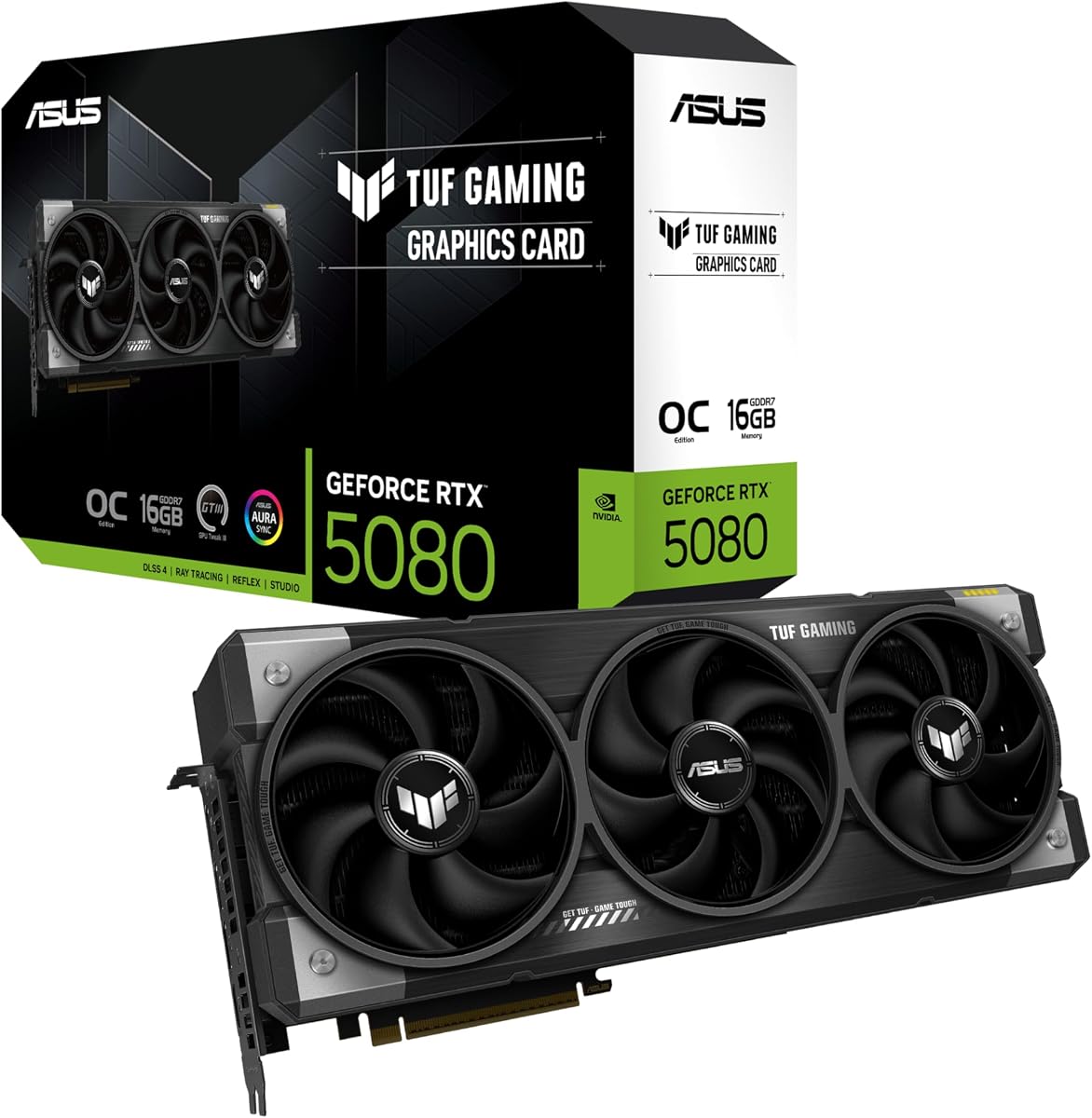
The ASUS TUF Gaming RTX 5080 is built for durability and high performance. It features military-grade components that extend the lifespan of the hardware. With 16GB GDDR7 memory, it handles AI tasks with impressive speed and bandwidth.
We may earn a commission when you buy through this link, at no additional cost to you.
The phase-change GPU thermal pad ensures optimal thermal performance and longevity compared to traditional paste. The three Axial-tech fans provide massive airflow. Auto-Extreme precision automated manufacturing further enhances the reliability of the card.
It is a large card requiring significant case space and a high-wattage power supply. These requirements might limit it to larger builds. However, its durability makes it a strong candidate for systems that run 24/7.
We recommend this card for users who need a robust and powerful local AI engine in a gaming or general-purpose PC. It handles demanding workloads with ease and stability.
Military-grade components and protective PCB coating protect the card against moisture and dust, extending its operational life.
Phase-change thermal pads offer superior conductivity, ensuring the GPU stays cool under heavy AI workloads for longer periods.
We may earn a commission when you buy through this link, at no additional cost to you.
The ASUS Turbo Radeon AI PRO is explicitly designed for running LLMs locally. It features 128 AI Accelerators and up to 1,531 TOPS, delivering fast inference. The 32GB GDDR6 VRAM allows large models to run without offloading.
We may earn a commission when you buy through this link, at no additional cost to you.
Multi-GPU scaling is supported for local AI clusters, making it scalable for larger projects. The wave-pattern design on the shroud cuts memory temperature by up to 16%. Phase-change thermal pads ensure consistent performance under heavy loads.
The rating suggests some users may have encountered specific configuration challenges. It is a specialized card not meant for gaming. If you prioritize raw AI performance and cluster scaling, it is a powerful option.
We recommend this card for developers building local AI clusters. It is ideal for users who need to run complex models on-premises without cloud dependencies.
This GPU is optimized for local language model workflows, offering up to 1,531 TOPS for fast inference and fine-tuning.
PCIe 5.0 and 2-slot design support dense multi-GPU builds, allowing you to scale performance for local AI clusters.
We may earn a commission when you buy through this link, at no additional cost to you.
The ASUS Dual RTX 5060 Ti is a compact card that delivers strong AI performance in a small form factor. With 767 AI TOPS, it is capable of handling local inference tasks efficiently. The 16GB GDDR7 memory ensures fast data access.
We may earn a commission when you buy through this link, at no additional cost to you.
Its 2.5-slot design maximizes compatibility and cooling efficiency for small chassis. Dual BIOS lets you toggle between Quiet and Performance profiles. Dual ball fan bearings provide long-lasting durability compared to sleeve bearings.
The compact size is a major benefit for smaller workstations. However, the core count may limit performance for very large models compared to higher-end cards. It is best suited for users with space constraints.
We recommend this card for small form factor PCs that need AI capabilities. It is ideal for users with limited case space who still require decent local model performance.
The 2.5-slot design allows this card to fit into small chassis while maintaining high cooling efficiency and performance.
0dB technology ensures silent operation during light tasks, making it suitable for office or home environments.
We may earn a commission when you buy through this link, at no additional cost to you.
The Tesla L40S is a specialized graphics accelerator designed for high-performance computing tasks. With 48GB of memory, it can handle extremely large models that consumer cards cannot. It is built for enterprise and data center environments.
We may earn a commission when you buy through this link, at no additional cost to you.
Its architecture is optimized for AI and HPC workloads rather than consumer graphics. The card typically comes without standard display outputs, targeting server deployments. It offers unmatched stability for continuous operation.
This card is not for standard desktop PCs. It requires specialized hardware and driver support. For users building dedicated AI servers, it is a powerful and stable choice.
We recommend this card for data center professionals and researchers building dedicated AI servers. It is ideal for workloads requiring massive memory capacity and reliability.
With 48GB of VRAM, this accelerator can host large language models that would otherwise require cloud services.
The L40S is optimized for high-performance computing, ensuring stability and speed for complex scientific and AI tasks.
We may earn a commission when you buy through this link, at no additional cost to you.
The NVIDIA RTX PRO 6000 Max-Q is a workstation monster designed for advanced data science. It packs 96GB of next-gen GDDR7 ECC memory, allowing you to run the largest models locally. With 3,511 TOPS of AI performance, it is incredibly fast.
We may earn a commission when you buy through this link, at no additional cost to you.
This dual-slot card fits into standard desktops but delivers server-level capabilities. It eliminates VRAM bottlenecks entirely. The 300W power cap ensures efficiency even under heavy loads. The thermal management makes multi-GPU scaling viable.
The price is high and is intended for serious professionals. It is not needed for simple tasks. However, for complex simulations and large LLMs, it offers unmatched local performance.
We recommend this GPU for research labs and enterprise teams needing top-tier local compute. It is the best choice for running large open-source models without offloading.
With 96GB of ECC memory, you can host massive open-source LLMs locally without needing to offload data to the system RAM.
Despite its power, the card caps at 300W, making it efficient for multi-GPU scaling in standard desktop workstations.
We may earn a commission when you buy through this link, at no additional cost to you.
The NVIDIA RTX PRO 6000 Blackwell is a professional workstation edition designed for AI and engineering. It features 96GB DDR7 ECC memory and 5th Gen Tensor cores, which deliver up to 3X performance. The bandwidth reaches 1.8 TB/s.
We may earn a commission when you buy through this link, at no additional cost to you.
Universal MIG support allows you to divide the card into multiple isolated instances for secure isolation. The double-flow-through cooling design sustains peak performance under 600W loads. It is a true powerhouse for enterprise workflows.
The export regulations require strict adherence to US rules. This card is strictly for professional use. For those who need maximum power, it is the best available option.
We recommend this card for enterprise engineers and researchers. It is ideal for teams that need secure, isolated GPU instances for multiple users.
Universal MIG support allows a single card to be divided into multiple isolated instances for secure isolation of applications.
Double-flow-through cooling design optimizes efficiency and airflow to sustain peak performance under high power loads.
We may earn a commission when you buy through this link, at no additional cost to you.
Choosing the right GPU for local large language models involves weighing several technical factors to ensure optimal performance.
VRAM is the most critical factor for running LLMs locally. The model weights must reside in GPU memory. 16GB is good for smaller models, while 24GB or 32GB is better for larger ones. 96GB is needed for massive models without quantization.
Always ensure your GPU has enough VRAM to hold your target model's size.
Bandwidth determines how fast data moves between the GPU cores and memory. High bandwidth ensures faster token generation. Look for cards with wide bus widths and fast memory types like GDDR7.
Higher bandwidth reduces latency during inference and improves overall speed.
Dedicated AI cores like Tensor Cores or XMX engines accelerate matrix operations. These are essential for fast inference. Check if the architecture supports the specific precision you need.
Ensure the card has enough AI cores to handle your workload efficiently.
If you plan to scale performance, look for GPUs that support multi-GPU scaling. This allows multiple cards to work together on a single model. Linux environments often offer better multi-card flexibility.
Check the software and driver compatibility for your specific multi-card setup.
Consider the software libraries and drivers required for your AI tasks. NVIDIA has the widest support for common frameworks. AMD and Intel cards offer good alternatives but may require more setup.
Verify driver support for your specific AI framework before buying.
Local inference often involves long runtimes. Efficient cooling prevents thermal throttling. Blower-style coolers are often better for multi-GPU setups. Air coolers work well for single-card systems.
Ensure the cooling system matches your chassis and workload requirements.
High-performance GPUs draw significant power. Ensure your power supply can handle the card's TDP. Professional cards often have lower power caps for efficiency.
Always verify your PSU capacity before purchasing a high-end GPU.
The physical size of the card matters for case compatibility. Some high-end GPUs take up three or four slots. Multi-GPU setups require sufficient spacing.
Measure your case clearance to ensure the card fits physically.
Install the latest drivers from the manufacturer to ensure compatibility with AI libraries. Verify that your operating system supports the required software versions.
Monitor temperatures using tools like GPU Tweak III or other utilities. Ensure proper airflow in your case to prevent overheating during long tasks.
Clean dust from fans regularly to maintain cooling efficiency. Update your AI frameworks and drivers periodically to benefit from new optimizations.
For small to medium models, 16GB is sufficient. For larger models, 24GB or 32GB is recommended. To run the largest models without quantization, look for cards with 48GB or more.
NVIDIA offers the widest ecosystem support for AI libraries. AMD and Intel provide viable alternatives, especially for Linux-based setups. The choice often depends on your specific software stack.
Professional cards often have higher memory capacity and better cooling for continuous operation. Gaming cards may have slightly faster raw compute in some cases but less stability.
Yes, many cards support multi-GPU scaling. Linux environments are often better suited for this. Verify driver compatibility before attempting a multi-card setup.
PCIe 5.0 provides higher bandwidth between the CPU and GPU. This helps reduce bottlenecks when loading models. It is future-proof but not always essential for current models.
Quantization reduces model size by lowering precision. You can use libraries like llama.cpp to run quantized models on cards with lower VRAM. This allows running larger models on consumer hardware.
Selecting the right GPU depends on your model size and budget. The top picks offer a range of options from budget-friendly to enterprise-grade. Consider memory capacity and driver support when deciding.
Prioritize VRAM if you plan to run large models without offloading. Ensure the cooling system matches your setup. Balance performance needs with power requirements.
Always check current availability and specifications before purchasing. The AI hardware landscape changes rapidly. Verify compatibility with your software stack.