
Entina Tina2C
4.4Editor score
WiFi & Offline Print
Auto Leveling System
STEM Learning Modules
Discover the top 3D printers for educational use, comparing speed, safety, and ease of use for students and teachers in classrooms and home learning environment
Choosing the right 3D Printer for Educational Use requires balancing speed, safety, and ease of setup for students and teachers. Modern devices offer auto-leveling and quiet operation to ensure smooth learning experiences without constant technical intervention during class time.
We evaluated ten leading models based on their build quality, filament compatibility, and educational features like STEM modules or app control. Each product was selected for its ability to inspire creativity while maintaining reliable performance for repeated use in busy school labs or home desks.
Each pick below highlights key strengths such as fast printing speeds, enclosed safety designs, or multi-color capabilities for complex projects. Keep in mind that product availability and offers may shift, so always check the latest details before making your final selection for your classroom or studio.
4.4Editor score

4.7Editor score

4.5Editor score
This comparison table outlines the core specifications and capabilities of each selected 3D Printer for Educational Use to help you decide which model aligns best with your specific classroom needs and project goals.





The Bambu Lab A1 stands out as a top choice for educational settings due to its fully automatic calibration and high-speed printing. With a rating of 4.7, it delivers precise results with minimal manual intervention, making it ideal for students eager to start creating immediately without frustration.
We may earn a commission when you buy through this link, at no additional cost to you.
Its standout strength is the full-auto calibration process, which eliminates the tedious manual bed leveling often found in older models. Active flow rate compensation ensures smooth prints, while the 1-Clip quick swap nozzle simplifies maintenance for teachers managing multiple units in a busy classroom environment.
While the multi-color printing requires an optional AMS lite module, this keeps the base unit affordable and simple. The active motor noise canceling keeps sound levels low, ensuring it does not disrupt other activities. This balance of performance and ease makes it a highly adaptable tool for learning.
We recommend the A1 for schools needing a reliable, high-performance machine that students can operate independently. Its robust build and intuitive interface reduce downtime, allowing more time for creative engineering projects. It is a smart investment for educators prioritizing both quality and workflow efficiency.
Full-auto calibration removes manual setup hassles, ensuring every print starts with optimal Z-offset and bed leveling for consistent first layers.
Active motor noise canceling keeps the environment peaceful, while the user-friendly interface allows students to focus on design rather than technical adjustments.
We may earn a commission when you buy through this link, at no additional cost to you.
The FLASHFORGE Adventurer 5M offers impressive speed capabilities with its CoreXY all metal structure, making it suitable for rapid prototyping projects. It features one-click automatic printing which simplifies the first layer setup, ensuring consistent adhesion without requiring students to manually adjust the bed frequently.
We may earn a commission when you buy through this link, at no additional cost to you.
Its direct extruder reaches 280°C, allowing for a wider range of materials, and the nozzle can be swapped in just 3 seconds to adapt to different print needs. This efficiency helps maintain momentum during class sessions, minimizing wait times between design iterations and final outputs for student projects.
While the user rating suggests some variability in experience, the smart mobile control via Flash Studio enables teachers to monitor progress remotely. This feature is particularly useful in large classrooms where physical supervision of every machine is challenging, ensuring prints stay on track without constant staff intervention.
This printer is a solid option for educational programs focused on speed and material versatility. With quick maintenance features and remote monitoring, it supports an active learning environment where students can test ideas quickly and iterate designs effectively without being bogged down by technical limitations.
CoreXY all metal structure maximizes efficiency and precision with 600mm/s travel speed, reducing production cycles for mass student projects.
Flash Studio app allows real-time monitoring and setting adjustments remotely, ensuring seamless control for teachers managing multiple devices.
We may earn a commission when you buy through this link, at no additional cost to you.
The Bambu Lab P1S features a fully enclosed body that improves safety and print performance for advanced filaments often used in engineering courses. With auto bed leveling and a setup time of just 15 minutes, it allows educators to spend more time teaching concepts rather than troubleshooting hardware issues in class.
We may earn a commission when you buy through this link, at no additional cost to you.
Its acceleration of 20000 mm/s² enables lightning-fast printing, letting students focus on creating rather than waiting for long print cycles. The ability to support up to 16 colors with an optional AMS connection adds a creative dimension for design projects where color distinction is necessary for complex assemblies.
While the higher price point reflects its advanced capabilities, the reliability and ease of use make it worthwhile for dedicated makerspaces or advanced high school programs. The enclosed design also minimizes external disturbances, ensuring consistent temperatures for more reliable prints even when ambient conditions fluctuate in a busy lab.
We recommend the P1S for educational settings requiring robust performance and advanced material support. Its enclosed structure offers a safer environment for students, while the speed and automation features keep the workflow efficient. It is an excellent choice for institutions ready to invest in higher-quality learning tools.
Fully enclosed body improves print performance for advanced filaments while providing a safer environment for students working with hot components.
500mm/s speed and high acceleration let students focus on creating and iterating designs without long waits during school hours.
We may earn a commission when you buy through this link, at no additional cost to you.
The FLASHFORGE AD5M combines brand-new technology with superior craftsmanship to meet the needs of both beginners and seasoned professionals in educational environments. Its fully automatic one-click leveling system ensures a flawless first layer every time, reducing frustration for students new to 3D printing technology and setup.
We may earn a commission when you buy through this link, at no additional cost to you.
The durable All-Metal CoreXY structure ensures high-speed printing without compromising quality, even in high-speed mode, while the flexible double-sided PEI steel plate makes model removal easy. If electricity shuts down, the resume feature saves the ongoing layer, preventing material waste and ensuring projects are completed once power returns.
The Orca-flashforge slicer enables network monitoring, which is beneficial for schools managing multiple printers. This control over device management and remote status viewing helps educators keep track of class-wide progress efficiently. The quick-swap nozzle further simplifies maintenance, reducing downtime when changes are needed during a project run.
This model is well-suited for schools looking for a reliable workhorse that minimizes technical headaches. Its ease of maintenance and ability to handle interruptions make it a practical choice for budget-conscious institutions that still demand performance. It is a solid pick for general engineering and design classes.
Fully automatic one-click leveling system precisely measures nozzle-to-build plate distance to ensure accurate offsets without manual tools.
Resume prints after outages save the ongoing layer and continue from that point when power is restored, reducing material waste significantly.
We may earn a commission when you buy through this link, at no additional cost to you.
The Entina Tina2C is designed specifically for first-time users and kids, allowing them to start their first 3D print in as fast as 8 minutes. Powered by the Poloprint Cloud app, it offers AI-powered search and over 20 creative DIY modules that turn creativity into an engaging educational experience for young learners.
We may earn a commission when you buy through this link, at no additional cost to you.
Its intelligent auto-leveling system reduces manual bed adjustment, ensuring better first-layer adhesion without complex calibration. The flexible magnetic build plate allows easy model removal with a simple bend, while the quick-swap printhead structure makes maintenance simple even for first-time users, reducing downtime significantly during active use.
Despite its compact size, it supports both 2.4G WiFi printing and TF card offline mode, giving users flexible ways to create anytime without relying on a constant internet connection. Integrated LED lighting provides clear visibility of print progress without harsh glare, supporting a more comfortable user experience for detailed work.
We recommend the Tina2C for home classrooms or elementary STEM programs needing an affordable and user-friendly entry point. Its focus on ease of use and safety features ensures a frustration-free experience. It is an excellent budget option to introduce students to the basics of 3D printing and design.
Fully assembled and guided setup through the app allows users to start printing in 8 minutes, making 3D printing simple and fun.
Regularly updated STEM learning courses and interactive tools turn creativity into an engaging educational experience for kids and families.
We may earn a commission when you buy through this link, at no additional cost to you.
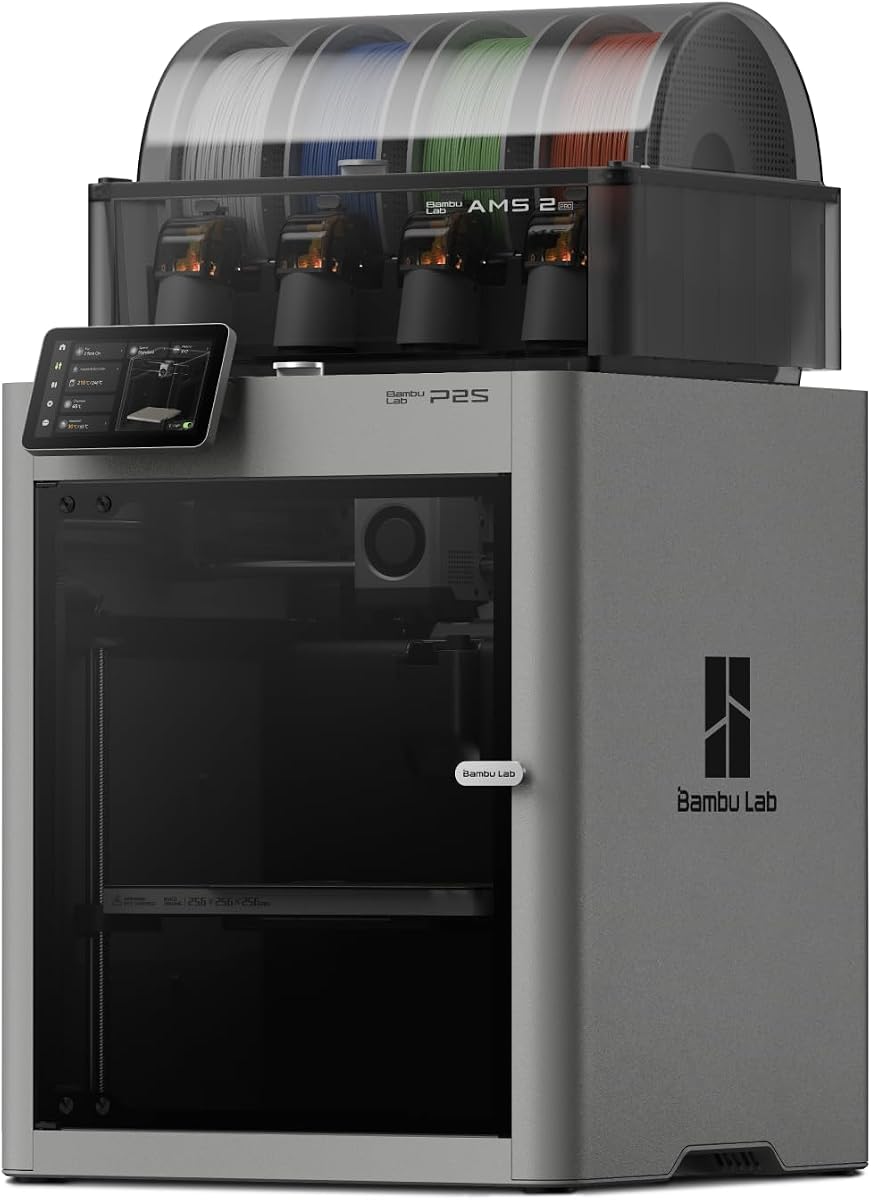
The Bambu Lab P2S Combo brings professional-grade features to educational use with its multi-color printing capabilities and high-speed precision. With an acceleration of 10,000 mm/s², it maintains exceptional accuracy, ensuring every layer stays sharp and smooth even during complex multi-material projects for advanced students.
We may earn a commission when you buy through this link, at no additional cost to you.
The AMS 2 Pro enables seamless multi-color printing and features built-in filament drying at up to 65°C, keeping every spool ready for flawless prints. The Adaptive Airflow System automatically balances cooling and heat retention, which is crucial for engineering-grade materials often used in high school or college-level courses.
Setup is quick, taking just 15 minutes, with AI failure detection and automatic calibration making professional-grade printing accessible. However, the higher price point and complex workflow may be best suited for dedicated makerspaces rather than general classrooms. It offers limitless creativity with a unified workflow from design to finished print.
We recommend this combo for specialized educational programs requiring high-quality output and multi-material capabilities. Its ability to handle different filament types reliably reduces failed prints. It is a powerful tool for institutions aiming to produce professional-grade prototypes and detailed models for academic projects.
AMS 2 Pro enables seamless multi-color printing with built-in filament drying, keeping spools ready for flawless and detailed student projects.
Adaptive Airflow System balances cooling and heat retention automatically, ensuring consistent results for advanced engineering materials.
We may earn a commission when you buy through this link, at no additional cost to you.
The Ugee Funbox is designed as a fully enclosed and UL GREENGUARD Gold certified printer, ensuring safety and clean air for kids. With zero calibration and a 12000 toy library, it turns a child's room into a factory for endless DIY fun, making it easy for kids to start creating independently without adult help.
We may earn a commission when you buy through this link, at no additional cost to you.
Its patented leveling-free technology guarantees a perfect first print every time, while the built-in HD camera streams live progress to phones. This allows students to watch their creations take shape and share time-lapse videos. The AI engines turn text or photos into printable models instantly, removing technical barriers to entry.
Although it focuses on single-color PLA printing, this simplicity helps children understand the basics of 3D modeling without overwhelming complexity. The H12 HEPA and activated carbon filters capture up to 99.5% of ultrafine particles, reducing odors and airborne dust effectively. This makes it ideal for home classrooms and shared spaces.
We recommend the Funbox for younger students or home education settings prioritizing safety and ease of use. Its focus on creativity and safety ensures a positive experience. It is a perfect gift for curious minds who want to learn engineering and design through hands-on play without technical frustration.
UL GREENGUARD Gold low-emission standards ensure clean air and non-toxic materials for safe classroom and home use environments.
AI engines turn text and photos into printable models instantly, allowing kids to design and build without needing complex software skills.
We may earn a commission when you buy through this link, at no additional cost to you.
The FLASHFORGE Adventurer 5M ensures success with a perfect first layer through full-auto one-click leveling, making quality printing accessible for beginners. From unboxing to starting printing, it takes only 10 minutes, which is perfect for educational environments where time is limited and students need to start working immediately.
We may earn a commission when you buy through this link, at no additional cost to you.
Vibration compensation eliminates ghosting in prints, ensuring smooth results with the 280°C nozzle heating up in just 35 seconds. The flexible removable PEI steel plate supports various materials like PLA and TPU. Filament runout sensors prevent waste when spools run empty during long class projects.
The open design allows for well-ventilated environments, suitable for classrooms with proper airflow. Power loss recovery lets users resume from where they left off, saving time and materials. This reliability makes it a practical choice for school labs where interruptions might occur due to maintenance or power shifts.
We recommend this model for institutions needing a fast and easy-to-manage solution for general printing tasks. Its quick setup and maintenance features keep the class moving forward. It is a reliable workhorse for schools focused on speed and efficiency in their 3D printing curriculum.
Full-auto leveling and direct extruder let users start printing in just 10 minutes from unboxing, saving valuable instructional time.
Power loss recovery and filament runout sensor prevent failed prints, allowing students to resume work seamlessly without losing progress.
We may earn a commission when you buy through this link, at no additional cost to you.
The Snapmaker U1 features a robust 4-toolhead system that enables true multi-color printing without manual filament swaps, ideal for complex educational projects. With a 5-second tool changer, it reduces tool change time significantly, allowing students to produce functional parts and detailed models quickly during a single print run.
We may earn a commission when you buy through this link, at no additional cost to you.
Unlike traditional systems, it swaps toolheads instead of repeatedly loading filaments, reducing waste by up to 5X. This minimizes material costs over time, which is crucial for school budgets. It supports mixed-material printing, allowing rigid and flexible materials in one job for sophisticated engineering designs.
The built-in model library and Snapmaker Orca slicer simplify setup for beginners. Remote app control and AI-powered print monitoring allow educators to manage tasks from anywhere. While the cost is higher, the productivity gains and reduced waste make it a smart investment for advanced educational makerspaces.
We recommend the U1 for schools looking to produce professional-grade prototypes with multi-material capabilities. Its efficiency and advanced features support high-level learning. It is the best choice for institutions prioritizing innovation and advanced engineering training in their curriculum.
Automatic tool changer reduces tool change time from minutes to seconds, enabling faster and more efficient complex multi-material prints.
True multi-material printing combines rigid and flexible materials in one job, expanding design possibilities for advanced student projects.
We may earn a commission when you buy through this link, at no additional cost to you.
The Bambu Lab A1 Mini Combo delivers blazing-fast printing while maintaining exceptional accuracy and detail. With an acceleration of 10,000 mm/s², it is perfect for creating small, detailed parts for projects in a limited space. The multi-color printing with AMS lite brings designs to life in stunning detail.
We may earn a commission when you buy through this link, at no additional cost to you.
Full-auto calibration ensures seamless printing with precise Z-offset and bed-leveling automatically. The simplified touchscreen and 1-Clip quick swap nozzle make maintenance convenient for students. Active motor noise cancellation ensures the environment remains quiet, keeping distractions low during focused learning time in the classroom.
While the build volume is smaller, its compact footprint makes it ideal for individual student desks or smaller labs. The multi-color capability encourages creativity, allowing students to make visually appealing prototypes. It is a great way to introduce multi-material concepts without the bulk of larger industrial machines.
We recommend the A1 Mini for schools needing a compact yet powerful solution for multiple workstations. Its quiet and efficient design fits well in diverse environments. It is a smart pick for educators who want high-performance capabilities in a space-saving package for their students.
Compact footprint and blazing fast speed allow high-quality prints in limited spaces without compromising on accuracy or detail.
Simplified touchscreen and quick swap nozzle make maintenance convenient for students, ensuring easy access to controls without complex steps.
We may earn a commission when you buy through this link, at no additional cost to you.
Selecting the right 3D Printer for Educational Use involves considering several key factors that impact learning outcomes and operational efficiency in classrooms.
Educational environments often require equipment that students can operate independently. Look for printers with full-auto calibration and leveling systems that minimize manual adjustments. This ensures that class time is spent on design and engineering rather than troubleshooting hardware configurations.
Prioritize models with one-click setup features to reduce downtime and frustration for beginners.
When working with young students, safety is paramount. Enclosed designs protect fingers from hot nozzles and moving parts. Additionally, look for certifications like UL GREENGUARD Gold to ensure low-emission materials that maintain clean air quality in indoor learning spaces.
Ensure the printer includes safety features like auto-shutoff and safe surface temperatures.
Versatility in materials allows students to experiment with different properties like flexibility and strength. Extruders capable of reaching 280°C can handle a wider range of filaments, providing a better understanding of material science. This expands the scope of possible projects and learning outcomes.
Choose a printer that supports standard PLA and PETG at minimum to ensure broad compatibility.
Multi-color printing adds a creative dimension to educational projects, enabling realistic models and complex assemblies. Systems with automatic tool changers or AMS modules make this easier without manual intervention. This encourages students to focus on design aesthetics and functional integration.
Consider if the multi-color module is included or sold separately for budget planning.
Remote monitoring tools allow teachers to oversee multiple units without constant physical presence. WiFi control and mobile apps simplify the process of starting and stopping prints. This helps maintain control over workflow and ensures that projects are completed safely within class hours.
Ensure the printer supports app-based monitoring for easier supervision in large classes.
Fast printing speeds reduce wait times, allowing more iterations of design work during a single session. High acceleration and travel speeds ensure that students can see results quickly, keeping them engaged. This is crucial for maintaining momentum in fast-paced STEM activities.
Look for printers with speeds above 500mm/s to maximize production efficiency.
Budget is always a factor for schools and home users. While higher-end models offer more features, entry-level devices often provide excellent value for basic learning. Assess the total cost of ownership, including maintenance parts and consumables, to ensure long-term affordability.
Compare the initial price against the expected lifespan and support offerings provided by the manufacturer.
Some brands offer dedicated educational content, libraries of models, or STEM courses. These resources help teachers integrate 3D printing into the curriculum effectively without needing to create materials from scratch. Access to a vast library of pre-tested designs can inspire creativity and save time.
Check if the printer includes access to educational modules or model libraries.
Before starting a project, ensure the print bed is clean and calibrated correctly. Most modern educational printers handle this automatically, but it is good practice to check the surface for dust or debris. Use a soft cloth to wipe the build plate if necessary to maintain strong adhesion.
Monitor your prints regularly, especially during the first few layers. Utilize the built-in camera or mobile app to watch progress remotely. This helps catch any potential issues early, such as filament jams or detachment, preventing wasted time and material during class hours.
Maintain your printer by cleaning the nozzle and checking belts for tension periodically. Store filament in a dry environment to prevent moisture absorption. Regular maintenance ensures consistent performance and extends the lifespan of your equipment for future educational use.
The Bambu Lab A1 is highly recommended for classrooms due to its fully automatic calibration and quiet operation. It allows students to focus on design without complex setup, making it ideal for educational settings where time is limited.
Yes, enclosed printers like the Bambu Lab P1S provide a safety barrier against moving parts and hot surfaces. They also help contain fumes and maintain consistent temperatures for better print quality in various environments.
Absolutely. Many educational models feature auto-leveling and app control that guide users through the process. With intuitive interfaces, even young students can start printing simple models within minutes of unboxing.
Choose printers with certifications like UL GREENGUARD and features like auto-shutoff. Always supervise students, ensure proper ventilation, and teach them safe handling practices for hot nozzles and materials.
While not strictly necessary, it enhances creativity and design learning. Models like the Snapmaker U1 allow multi-color prints which help students understand how different materials and colors interact in functional designs.
Regular maintenance includes cleaning the nozzle, checking belt tension, and lubricating moving parts. Storing filament properly also prevents moisture issues. Most modern printers have self-cleaning features to reduce these tasks.
Choosing the right 3D Printer for Educational Use ultimately depends on your specific classroom needs and budget constraints. The Bambu Lab A1 offers exceptional ease of use, while options like the Entina Tina2C provide an affordable entry point for younger students.
For schools focused on advanced engineering, the Snapmaker U1 provides multi-material capabilities that unlock professional-grade projects. Consider factors like safety certifications, print speed, and remote monitoring when making your final decision for your institution.
Remember to check the current product details before purchasing as specifications and availability can change. Investing in the right tool will empower your students to explore creativity and engineering concepts with confidence.